If your skin has started to feel less firm, your jawline is not quite as defined as it used to be, or fine lines are becoming more noticeable, you may have come across XERF.
XERF is a newer non-surgical radiofrequency treatment that uses controlled heat to target tissue beneath the skin. The aim is to encourage changes in skin firmness and quality over time, without needles, incisions or surgery.
If you are considering XERF skin tightening treatment in Sydney CBD, it is worth understanding what the treatment actually does before deciding whether it is right for you.
So, what exactly is XERF? How does it work? What does treatment feel like? And perhaps most importantly, what kind of result can you realistically expect?
This guide covers the technology, treatment areas, potential benefits, recovery, results, safety and how XERF compares with other popular skin-tightening treatments.
What Is XERF Skin Tightening?
XERF is a non-invasive monopolar radiofrequency treatment that uses two radiofrequency frequencies: 6.78 MHz and 2 MHz.
The technology delivers controlled RF energy into the treated area, creating heat within the tissue. That controlled thermal effect is intended to influence collagen-rich structures and support the skin’s natural remodelling process.
Unlike a facelift, XERF does not involve surgery or removal of excess skin. And unlike RF microneedling, there are no needles penetrating the skin.
This makes XERF an option for people who want to address changes in skin firmness or mild laxity while avoiding a surgical procedure.
XERF has received FDA clearance in the United States, and clinical research into dual-frequency monopolar RF is continuing. Because the technology is relatively new, it is important to look at the available evidence realistically rather than assuming that every claimed benefit has already been firmly established.
What does XERF stand for?
XERF is the name of a specific dual-frequency monopolar RF technology developed by Cynosure-Lutronic. It is not simply another name for radiofrequency skin tightening in general.
The distinction matters because there are many RF devices on the market, and their energy delivery systems, frequencies, applicators and treatment protocols can differ.
How Does XERF Work?
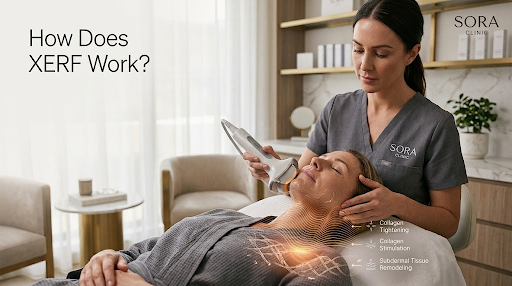
At its simplest, XERF works by delivering radiofrequency energy into tissue and converting that energy into heat.
Controlled heating is important because thermal stimulation can affect collagen-containing tissue and initiate biological processes involved in tissue remodelling.
There can also be an early tightening effect related to the contraction of existing collagen fibres. Longer-term changes are thought to be associated with the body’s response to the controlled thermal treatment.
One of the features that distinguishes XERF is that it uses two RF frequencies rather than a single frequency.
6.78 MHz RF
The higher-frequency component is associated with heating in more superficial tissue structures, including dermal and collagen-rich layers.
2 MHz RF
The lower-frequency component can create a deeper thermal effect within tissue.
Why use two frequencies?
The idea behind dual-frequency treatment is not simply that “two frequencies are better.”
Different frequencies can produce different patterns of energy interaction and tissue heating. In practice, the treatment approach also depends on the applicator, energy settings, treatment area, tissue characteristics and the clinician’s technique.
That gives the clinician greater flexibility when treating different areas of the face or neck.
What Are the Potential Benefits of XERF?
XERF is primarily used when the concern relates to reduced firmness or mild to moderate skin laxity.
Depending on the individual, treatment may be considered for:
- Mild to moderate skin laxity
- Softer lower-face definition
- Less defined jawline appearance
- Reduced firmness around the cheeks
- Fine lines
- Changes in skin texture
- Selected neck laxity
- Overall skin firmness
The important point is that not every change in facial appearance is caused by loose skin.
For example, volume loss, changes in facial structure, muscle activity or excess fat beneath the chin can all influence the way the face looks. Tightening the skin alone will not address every one of these concerns.
That is why the assessment matters just as much as the treatment itself.
What Areas Can XERF Treat?
XERF can be used on selected areas of the face and neck, with the treatment approach adjusted according to the patient’s anatomy, skin quality and concerns.
Face
Facial treatment may be considered when reduced firmness or changes in skin quality are contributing to a less youthful or less defined appearance.
Lower Face
The lower face can gradually lose definition as skin elasticity changes with age. Where mild laxity is a significant part of the concern, RF treatment may help improve the appearance of firmness.
Jawline
A softer jawline can sometimes be partly related to skin laxity. XERF may help create a firmer-looking contour in suitable patients, although it does not remove significant fat or excess skin.
Neck
Fine lines, crepey texture and mild looseness can become more noticeable in the neck over time. XERF may be considered for selected neck concerns following an assessment.
Is XERF Suitable for Mild or Moderate Skin Laxity?
XERF tends to make the most sense when the concern is mild to moderate laxity, rather than a large amount of excess skin.
You may want to discuss XERF if you have noticed:
- A gradual loss of firmness
- Early softening around the jawline
- Mild lower-face laxity
- Mild neck laxity
- Fine lines associated with ageing
- A preference for non-surgical treatment
- A preference for gradual rather than dramatic change
There is another reason an assessment is important: what looks like loose skin may not always be loose skin.
Loss of facial volume, underlying anatomy, submental fullness and other changes can all contribute to facial contour. Treating the wrong underlying issue is unlikely to produce the result you are looking for.
What XERF Cannot Do
Knowing what a treatment cannot do is just as important as knowing what it can potentially improve.
XERF does not:
- Remove significant excess skin
- Replace a surgical facelift
- Remove substantial under-chin fat
- Restore lost facial volume in the way a filler can
- Reverse advanced facial ageing
- Guarantee a particular degree of lifting
Someone with substantial excess skin may achieve a more significant correction with surgery.
Likewise, someone whose main concern is volume loss, pigmentation, acne scarring or excess submental fat may benefit from a completely different treatment.
A good treatment plan starts by identifying the actual cause of the concern rather than choosing a device first.
XERF vs RF Microneedling: Are They the Same?
No.
Both treatments use radiofrequency energy, but the way they deliver that energy is quite different.
XERF is a non-invasive monopolar RF treatment. The applicator delivers RF energy through the skin without needles.
RF microneedling, on the other hand, uses tiny needles to enter the skin and deliver RF energy at controlled depths.
Because the technologies work differently, the treatment experience and recovery can also differ.
RF microneedling is commonly considered for concerns such as acne scarring, enlarged pores and certain texture issues, while XERF is more closely associated with non-invasive skin tightening and firmness.
Neither is automatically the “better” treatment. The appropriate choice depends on what you are actually trying to treat.
What Does XERF Treatment Feel Like?
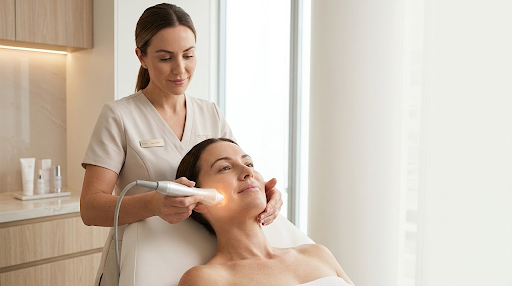
XERF uses controlled RF heating together with cooling at the skin’s surface.
During treatment, you may notice a sensation of:
- Warmth
- Heat
- Pressure from the applicator
- Short bursts of sensation as energy is delivered
- Mild to moderate discomfort in some areas
Everyone experiences treatment differently.
The treatment being non-invasive does not mean it will necessarily feel completely sensation-free. Comfort can change depending on the treatment area, energy settings, individual sensitivity and the number of passes or pulses used.
A 2026 retrospective study involving 16 women reported an average procedural pain score of 4.31 out of 10, although individual experiences varied.
Does XERF Hurt?
There is no single answer that applies to everyone.
Some patients describe XERF as a manageable sensation of heat or warmth, while others find particular areas more sensitive.
Comfort can be influenced by:
- The treatment area
- Energy settings
- Individual sensitivity
- Skin and tissue characteristics
- Treatment technique
- Number of passes or pulses
The clinician should adjust treatment parameters according to both the clinical objective and the patient’s tolerance.
Is There Any Downtime After XERF?
One of the reasons people consider non-invasive RF treatments is the relatively limited recovery compared with surgery.
XERF does not require needles or incisions, and there is no deliberate removal of the skin surface.
After treatment, some people may experience temporary:
- Redness
- Warmth
- Mild swelling
- Tenderness
- Sensitivity
These effects can vary in duration and intensity.
A small retrospective study published in 2026 reported mild and temporary reactions, including erythema and mild oedema. No thermal injury or persistent complications were observed in that study.
That does not mean complications are impossible. RF is an energy-based treatment, and inappropriate settings or technique can increase the risk of adverse effects.
When Will You See XERF Results?
XERF is not intended to produce the same immediate change as a surgical facelift.
Some patients may notice a temporary or early feeling of tightness, but the more meaningful changes are expected to develop progressively as the skin responds to the treatment.
The timing varies from person to person.
Factors that can influence the result include:
- Starting level of skin laxity
- Age
- Skin quality
- Treatment area
- Treatment settings
- Individual tissue response
Early clinical research has reported improvements following XERF treatment, but the available studies are still relatively small.
A 2026 prospective multicentre study assessed patients after two XERF treatments and followed them at 30 and 90 days after the second treatment. The researchers reported improvements in investigator-rated aesthetic outcomes and patient satisfaction.
A separate 2026 retrospective study involving 16 women also reported improvements in several measures of skin quality and facial appearance over three months.
These findings are encouraging, but they are still early evidence rather than proof that everyone will achieve the same result.
How Many XERF Treatments Will You Need?
There is no universal treatment schedule.
The number of treatments depends on factors such as your level of laxity, treatment area, skin quality, goals and response to treatment.
One 2026 prospective study used two treatments four weeks apart. That was the protocol used in that particular study, however, and should not be treated as a mandatory schedule for every patient.
Your clinician can recommend a treatment plan after assessing your skin and discussing what you want to achieve.
How Long Do XERF Results Last?
This is one area where it is sensible to be cautious.
XERF is a relatively new technology, and the published clinical research currently has relatively short follow-up periods.
The prospective 2026 study followed patients for up to 90 days after their second treatment, while another study followed patients for three months after a single treatment.
That means there is not yet enough long-term independent evidence to confidently tell every patient that their results will last a particular number of months or years.
Skin also continues to age after treatment. Sun exposure, genetics, lifestyle, age and baseline skin quality can all influence how long a cosmetic improvement remains noticeable.
What Does the Research Say About XERF?
The evidence surrounding XERF is developing, which is worth keeping in mind when reading online claims about the treatment.
A 2024 histological study reported changes in collagen and fibrous structures following dual-frequency monopolar RF treatment. This provides biological support for the proposed mechanism behind the technology.
A 2026 prospective multicentre study involving 39 adults evaluated patients following two treatments and reported improvements in aesthetic assessments and patient satisfaction.
Another retrospective study published in August 2026 looked at 16 women following a single treatment and reported improvements in several measures relating to facial skin quality and laxity.
The results are promising, but the studies are relatively small and follow-up remains limited. Larger controlled studies and longer-term independent research would provide a stronger understanding of how effective the technology is and how long the results can be maintained.
What does that mean if you are considering XERF?
It means XERF is a promising non-surgical RF option, but it should not be presented as a guaranteed solution or as automatically superior to every other skin-tightening treatment.
The more useful questions are whether it suits your particular concern, what level of improvement is realistic and whether there are alternative treatments that may be more appropriate.
Is XERF Safe?
XERF is an energy-based aesthetic treatment, so appropriate screening and treatment technique are important.
Before treatment, your clinician should review your medical history and discuss anything that could affect your suitability.
This may include:
- Implanted electronic devices
- Pacemakers or defibrillators
- Metal or other implants
- Active skin infections
- Open wounds
- Significant inflammatory skin conditions
- Recent procedures
- Pregnancy or breastfeeding
- Relevant medical conditions
- Medications that could affect treatment or healing
The exact precautions and contraindications should be assessed by the treating clinician.
Temporary redness, warmth, swelling or tenderness can occur. More significant complications are also possible with energy-based treatments, which is why appropriate patient selection, equipment, settings and clinical technique matter.
XERF vs Thermage: What’s the Difference?
XERF and Thermage are both monopolar radiofrequency technologies, but they are not the same treatment.
XERF uses 6.78 MHz and 2 MHz RF energy, while Thermage FLX uses 6.78 MHz RF.
They also differ in device design, treatment protocols and clinical history.
Instead of asking which treatment is universally better, it makes more sense to consider:
- Your treatment area
- Degree of laxity
- Desired outcome
- Previous treatments
- Comfort preferences
- Clinician experience
- Available evidence
There is currently not enough strong head-to-head evidence to establish that one is the best choice for every patient.
XERF vs Ultherapy: What’s the Difference?
XERF and Ultherapy use different forms of energy.
XERF: Monopolar radiofrequency.
Ultherapy: Microfocused ultrasound with visualisation.
Because the two technologies deliver energy differently, they should not be viewed as interchangeable.
The appropriate option depends on the patient’s anatomy, degree and type of laxity, treatment goals and clinical assessment.
Who Is XERF Best Suited For?
XERF may be worth discussing if you have mild to moderate skin laxity and want to explore a non-surgical approach.
It may be relevant for someone experiencing:
- Early lower-face laxity
- Mild jawline softening
- Mild neck laxity
- Reduced skin firmness
- Fine lines associated with ageing
- A preference for non-invasive treatment
- An expectation of gradual rather than dramatic results
It may be less appropriate when the main concern is significant excess skin, advanced laxity, substantial volume loss, significant submental fat or a problem that requires surgical correction.
The more useful question is not simply, “Can I have XERF?”
It is:
Is radiofrequency skin tightening actually appropriate for what is causing the change in my appearance?
What Should You Ask Before Having XERF?
A consultation should give you an opportunity to understand the treatment rather than simply decide whether to book it.
Useful questions include:
- What is causing my skin laxity?
- Is XERF suitable for my particular concern?
- What level of improvement is realistic?
- How many treatments might I need?
- What will the treatment feel like?
- What temporary side effects should I expect?
- Are there risks specific to my medical history?
- Are there other treatments I should consider?
- How long might the improvement remain noticeable?
- What are my options if XERF does not give me the result I want?
Understanding the limitations of a treatment is just as important as understanding its potential benefits.
Frequently Asked Questions About XERF
What is XERF skin tightening?
XERF is a non-invasive monopolar radiofrequency treatment that uses 6.78 MHz and 2 MHz RF energy to create controlled heating within targeted tissue. It is designed to support skin firmness and gradual tissue remodelling.
Is XERF the same as radiofrequency skin tightening?
XERF is a specific RF skin-tightening technology. It uses the same broad principle of creating controlled thermal energy as other RF treatments, but its dual-frequency system and device design distinguish it from conventional single-frequency RF platforms.
Is XERF non-invasive?
Yes. XERF delivers RF energy through the skin without needles or surgical incisions. However, non-invasive does not mean risk-free, so appropriate assessment is still important.
Does XERF tighten the jawline?
XERF may improve the appearance of a softer jawline when skin laxity is an important part of the concern. It does not remove significant fat or excess skin, so the result depends on what is actually causing the change in contour.
Can XERF treat the neck?
XERF may be considered for selected neck skin-firming concerns. Whether it is appropriate depends on the degree and cause of the laxity.
Is XERF painful?
Comfort varies between individuals. Many people experience warmth or heat during treatment, while some areas may feel more uncomfortable depending on the settings and individual sensitivity.
How long does XERF take to work?
XERF is intended to produce gradual changes. Some people may notice an early feeling of firmness, while visible changes can develop over the following weeks.
How many XERF treatments do I need?
There is no fixed number that applies to everyone. Treatment plans depend on the individual, and clinical studies have used different treatment schedules.
How long do XERF results last?
The long-term durability of XERF results is still being studied. Current published research has mainly followed patients for around three months, so it is too early to make a reliable universal claim about how many months or years results will last.
Is XERF better than Thermage?
Not necessarily. Both use monopolar RF, but they use different technologies. There is not enough high-quality head-to-head evidence to say that one is universally better for every patient.
Can XERF replace a facelift?
No. XERF is non-surgical and cannot remove significant excess skin or reproduce the level of correction possible with a facelift.
Is XERF suitable for everyone?
No. Suitability depends on factors including medical history, skin condition, treatment area and degree of laxity. A consultation is required before treatment.
Final Thoughts: Is XERF Worth Considering?
XERF is an emerging option for people who want to explore non-surgical skin tightening without needles or surgery.
Its dual-frequency monopolar RF system is designed to create controlled thermal effects within tissue, and early clinical research has reported improvements in facial laxity, skin quality and patient-reported outcomes.
At the same time, it is important to keep the evidence in perspective. XERF is still relatively new, published studies are small and long-term data is limited. A good treatment discussion should therefore focus on realistic improvement rather than promising a permanent or dramatic lift.
For someone with mild to moderate skin laxity who wants a gradual, non-surgical approach, XERF may be worth discussing with an appropriately qualified clinician.
The first step is working out whether skin laxity is actually the main reason for the change you are seeing — and whether XERF is the right option for your skin, anatomy and goals.
Considering XERF Skin Tightening in Sydney?
If you’re researching XERF treatment in Sydney, a personalised assessment can help determine whether radiofrequency skin tightening is appropriate for your skin and what level of improvement may realistically be achievable.
Explore XERF skin tightening treatment in Sydney CBD at SORA Clinic →